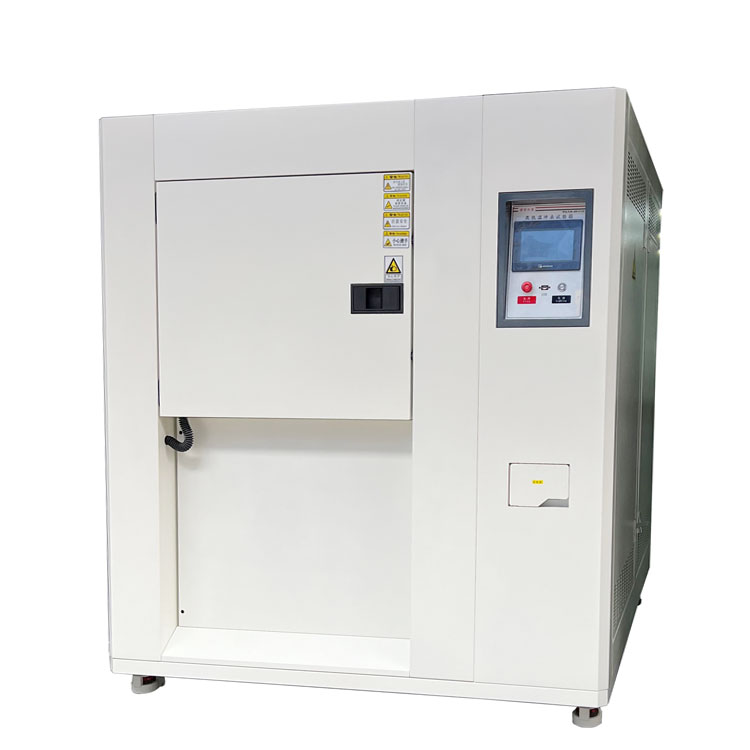
Thermal Shock Test Chamber
Thermal Shock Testing, also known as temperature shock testing or high-low temperature thermal shock testing, simulates the extreme temperature changes a product might experience during its design, development, production, transportation, installation, and use. It primarily assesses the thermal expansion and contraction properties of structural components. To some extent, thermal shock testing is considered a destructive test.
Thermal Shock Testing, also known as temperature shock testing or high-low temperature thermal shock testing, simulates the extreme temperature changes a product might experience during its design, development, production, transportation, installation, and use. It primarily assesses the thermal expansion and contraction properties of structural components. To some extent, thermal shock testing is considered a destructive test.
Test Purpose: Thermal shock test chambers are essential testing equipment for industries dealing with metals, plastics, rubber, electronics, and other materials. They are used to evaluate how materials or composite structures respond to sudden and extreme temperature fluctuations, which may cause chemical changes or physical damage due to thermal expansion and contraction.
Testing Phase: Thermal shock testing is mainly conducted during the research and development stage and the trial production phase.
Test Objects: Thermal shock test chambers are used to test the structural integrity or composite materials, most commonly electronic components or assemblies (such as PCBA and IC).
Test Structure: Thermal shock test chambers differ from rapid temperature change test chambers in structure. A thermal shock test chamber has two temperature zones inside: a high-temperature zone and a low-temperature zone.
Temperature Change Rate Requirements: The temperature change in thermal shock testing involves completing the transition between high and low temperatures within 5 minutes. This requires an instantaneous change in temperature, so it is often referred to as a temperature shock test chamber. There are also standards requiring temperature measurement on the product’s surface, with a temperature recovery time within 15 minutes. The temperature shock occurs under non-linear conditions. The principle of temperature shock involves high-temperature storage chambers delivering controlled temperatures to achieve high-temperature shock effects, and vice versa for low-temperature shock. The main objective of the test is temperature shock.
Sample Failure Modes: Failure in thermal shock testing is caused by material creep and fatigue damage, also known as brittle failure.
Common Failure Phenomena: Failures in thermal shock testing are typically manifested as deformations or breakages of components, insulation layer failures, mechanical parts jamming or loosening, electrical and electronic component changes, and issues caused by rapid condensation or frost leading to electronic or mechanical faults.
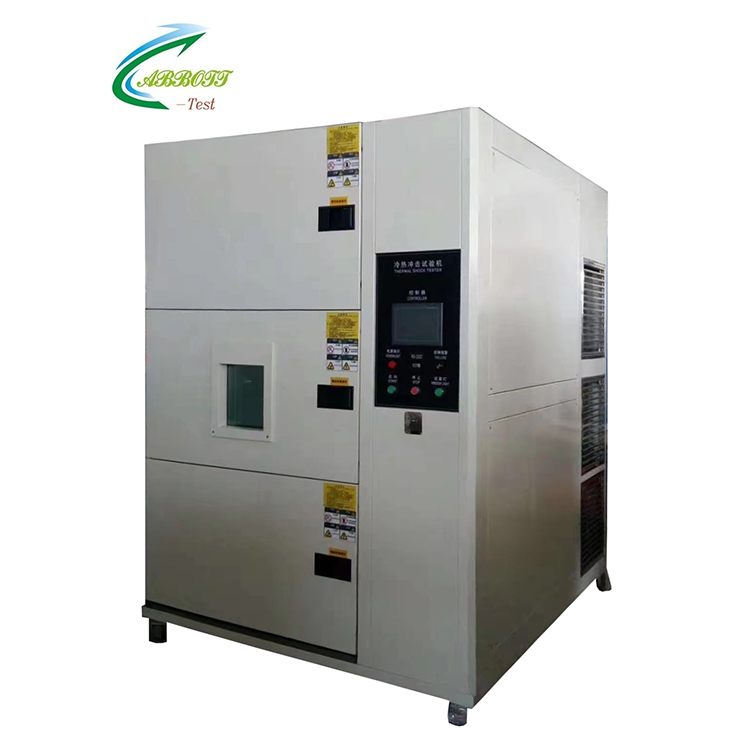
Rapid Rate Temperature Test Chamber
Rapid Temperature Change Testing is included in Environmental Stress Screening (ESS) and is an efficient method to improve product reliability.
Test Purpose: Rapid temperature change testing uses external environmental stress to expose early failures that may be caused by defective components, manufacturing processes, or other issues during the product’s research, design, and production stages, allowing for corrections and replacements.
Testing Phase: Rapid temperature change testing is primarily conducted during the mass production phase.
Test Objects: Rapid temperature change testing is mainly applied to electronic components, assemblies, and equipment.
Test Structure: Rapid temperature change test chambers differ from thermal shock test chambers in that they have only one chamber. This chamber can only exist at high or low temperatures at any given time. The temperature changes need to be achieved through heating or cooling, which is why it is also called a rapid temperature change test chamber. The temperature change rate is faster compared to standard high-low temperature test chambers but does not reach the rapidity of thermal shock test chambers.
Temperature Change Rate Requirements: Rapid temperature changes are completed within a specified time for both heating and cooling, and can be either linear or non-linear. For example, for a device with a temperature range from -40°C to 80°C, cooling from 80°C to -40°C at a rate of 5°C per minute would take 24 minutes to achieve -40°C, which is slower compared to thermal shock test chambers but faster than conventional high-low temperature test chambers. The temperature change rate can be controlled, with some devices capable of achieving rapid changes of 10°C to 30°C per minute. The test objective is rapid heating and cooling, hence the term rapid temperature change test chamber.
Sample Failure Modes: Failures in rapid temperature change testing are caused by material fatigue.
Common Failure Phenomena: Failures in rapid temperature change testing are often seen as the expansion of microcracks in coatings, materials, or wires; loosening of poorly bonded joints; loosening of improperly connected or riveted joints; deformation and stress due to differing thermal expansion coe.