

Temperature Shock Test Chambers are widely used in various industries including plastics, electronics, metals, rubber, and even defense. They are among the common material testing devices. Typically, these test chambers are used to assess the tolerance of materials or composite materials to rapid temperature changes, from high to low temperatures.They are suitable for research, quality inspection, schools, factories, military applications, and other units involved in testing electrical, electronic products, semiconductors, electronic circuit boards, metal materials, bearings, and other materials under conditions of drastic temperature changes. Utilizing temperature shock test chambers can effectively enhance product reliability and quality control.
Sample Operation Procedure for Temperature Shock Test Chambers:
Step 1: Sample Pre-treatment
Place the sample in normal atmospheric conditions until it reaches thermal stability.
Step 2: Initial Sample Inspection
Compare the sample with standard requirements. If it meets the requirements, place it directly into the cold and hot impact test chamber for testing.
Step 3: Sample Testing
This is the critical step where the test chamber performs the actual testing of the product.
First, the sample must be placed inside the test chamber according to the standards of the cold and hot impact test chamber. Set the chamber temperature to the designated test point and maintain it long enough for the sample to achieve thermal stability, based on the duration required.
Next, after completing the high-temperature test, transfer the sample to the low-temperature chamber, which should be set to -55°C, within 5 minutes. Maintain the sample in the low-temperature chamber for 1 hour or until the sample reaches thermal stability, based on the duration required.
Then, after finishing the low-temperature test, transfer the sample back to the high-temperature chamber, which should be set to 70°C, within 5 minutes. Maintain the sample in the high-temperature chamber for 1 hour or until the sample reaches thermal stability, based on the duration required.
Finally, to ensure the accuracy of the high and low-temperature impact test results, repeat the above steps for three cycles. The time may vary slightly depending on the sample size and chamber space.
Step 4: Recovery
After removing the sample from the chamber, allow it to recover in normal atmospheric conditions until it reaches thermal stability.
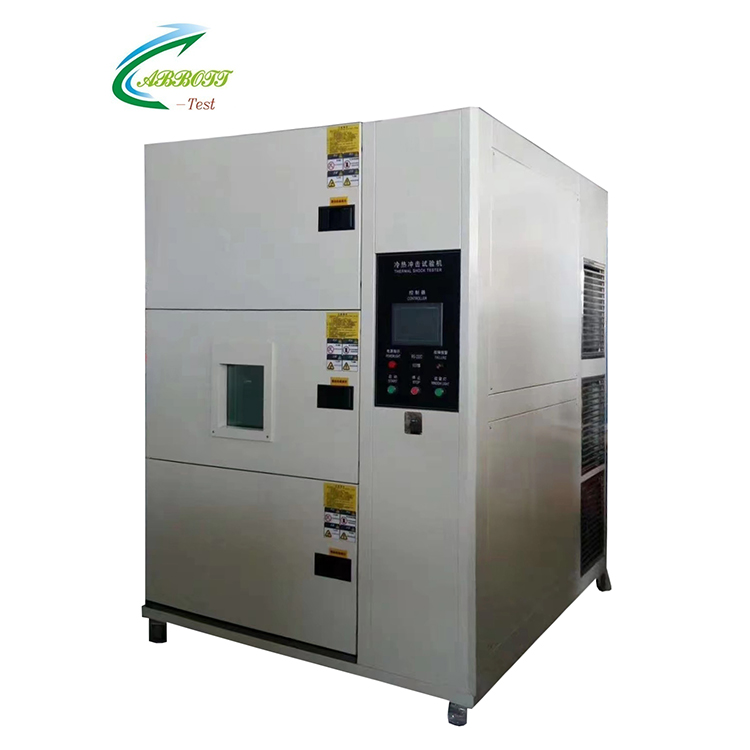
Usage Guidelines for Temperature Shock Test Chambers:
Before use, check the power supply and ensure it has a good grounding connection.
Before testing, ensure that the items being tested are not flammable or highly volatile.
Do not alter the internal components of the test chamber to prevent malfunctions that could affect the equipment’s lifespan.
It is crucial to clean the test chamber before and after testing, and perform necessary maintenance regularly.
When repairing the test chamber, always disconnect the power to prevent electric shock hazards.
Do not place flammable or explosive materials nearby to ensure safety in the testing environment.
The selection of environmental testing equipment is generally straightforward, based on engineering product testing specifications, standards, and principles. The same applies to temperature shock test chambers. The five main principles to follow include repeatability, reproducibility, controllability, exclusivity, and safety and reliability.
If you are interested in our products, please feel free to contact us.