

Simply by using a xenon lamp aging test, the degree of aging of a product, years or decades later, can be accomplished in a short period of time. For example: fading, discoloration, loss of brightness, chalk flowers, cracking, blurring, a decline in catalytic strength, and rainfall from hot and cold climates.
How many days does 1 hour of xenon lamp aging equal?
One hour of xenon aging is equivalent to between 0.42 days and 1 day in a natural environment.
One hour of xenon aging test is equivalent to about 18 hours in a natural environment, and 500 hours of testing is equivalent to one year in real-time.
What is the xenon lamp aging test standard?
The xenon lamp aging test standard is ISO 4892-3:2006.
It is an accelerated aging of samples by simulating the conditions of natural sunlight to evaluate the performance of items under various climatic conditions.
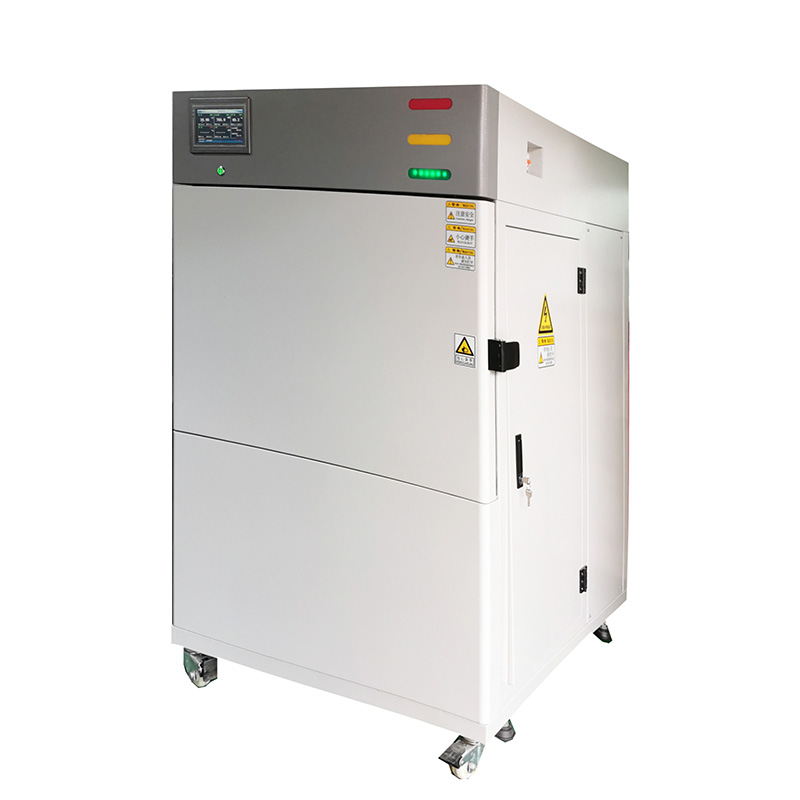
What are the xenon lamp aging test conditions?
The following are the test conditions to be met when using a xenon lamp aging test chamber for testing:
1. Xenon arc lamps are used, which can realistically simulate the solar spectrum and the radiation intensity of sunlight.
We are careful to ensure the stability and consistency of the light source in the testing process.
2. Testing the items, the temperature should be kept constant. The temperature range is between 45℃ and 55℃.
The stability and accuracy of the temperature are important. They ensure the reliability of the test results.
3. Testing the items, it is also important to maintain a certain relative humidity, the humidity range is generally between 50% and 60%.
This can simulate the natural humidity. It's also key to testing materials' weathering in real use.
4. In xenon lamp weathering testing, the light intensity setting is also important.
The choice of light intensity depends on the test specimen and the desired degree of aging.
In the ISO 4892-3:2006 standard, the light intensity ranges from 1.1 W/m² to 11 W/m².
It is important to note that the light intensity setting is recommended to be chosen according to the actual requirements. This will ensure the accuracy of the test results.
5. Irradiation time refers to the time the sample is exposed to the light source.
In the ISO 4892-3:2006 standard, the irradiation time is usually between 30 minutes and 8 hours.
In general, longer exposure times result in faster aging rates and more pronounced changes in performance.
But, long exposure times may cause overheating or other effects. on the accuracy of the test results.
Therefore. It is recommended that you set the exposure time according to the required test period of the article and the degree of aging of the sample.
6. In xenon lamp aging tests, the way the sample is placed will also have an impact on the test results.
It is recommended that the sample be placed flat or suspended to ensure uniform exposure to the light source. Adjust the spacing between the samples to prevent blocking or interfering with each other.
7. In xenon aging tests, filters are often used to filter out unwanted spectral components.
Filters include UV filters and visible light filters.
The filters are designed to simulate the UV and visible radiation found in the natural environment.
It is recommended that you configure them according to your testing needs and standard requirements.
Aibo is specialized in producing xenon lamp aging test chamber manufacturers. We provide you with high-quality product aging resistance tests.